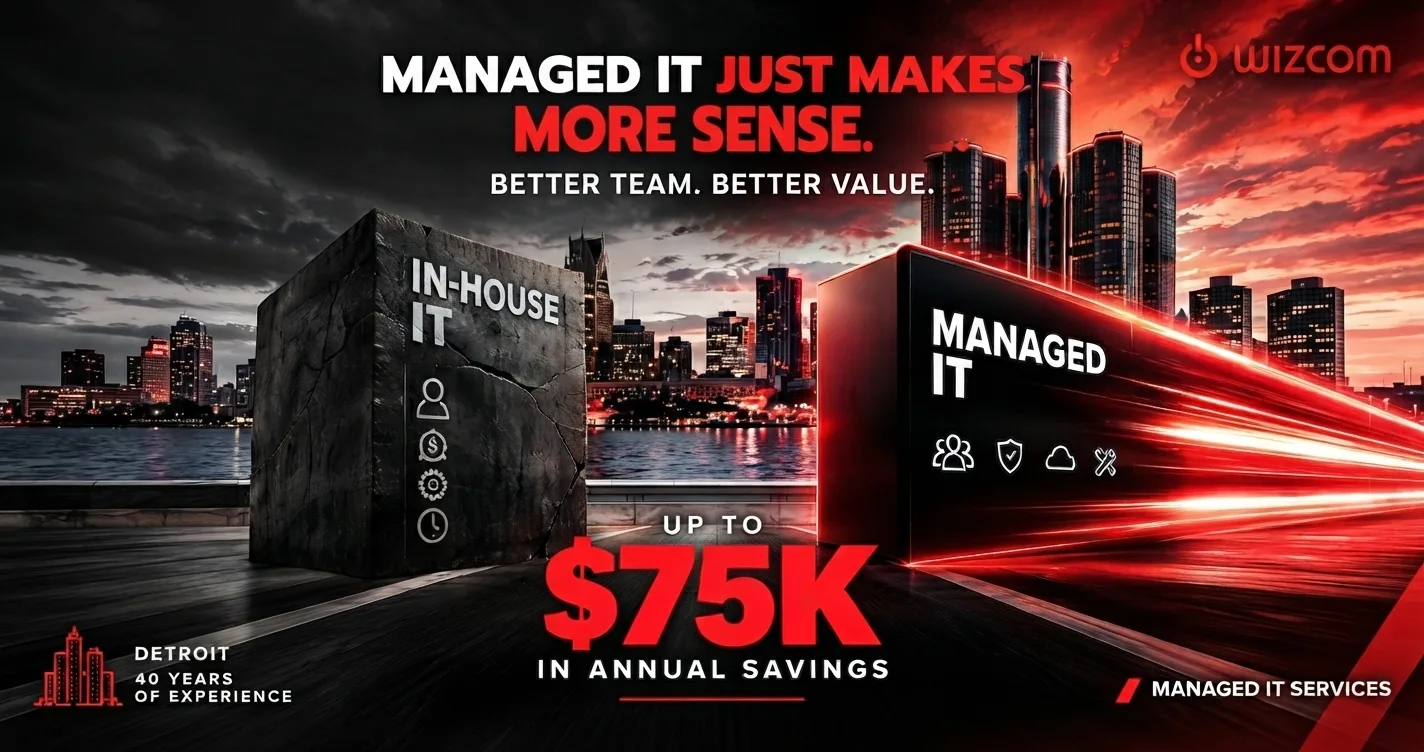
For most Detroit small and medium businesses under 75 employees, managed IT costs less. Usually a lot less.
Not because managed IT is cheap. Because in-house IT is far more expensive than the salary line suggests.
Here is the part that catches people off guard: the salary is roughly 60% of what that hire actually costs you.
What one in-house IT person really costs in Detroit
Let’s use real Detroit numbers, not national averages.
The average IT Support Specialist salary in Detroit sits around $68,400 per year according to ZipRecruiter’s July 2026 data. Glassdoor puts it at $69,083. Call it $68,000 to $69,000.
Now add what nobody puts in the spreadsheet:
| Line item | Annual cost |
|---|---|
| Base salary | $68,500 |
| Payroll taxes and benefits (approx. 30%) | $20,550 |
| Recruiting and onboarding | $4,700 |
| Certifications and training | $3,000 |
| Software stack (RMM, EDR, backup, ticketing) | $12,000 to $25,000 |
| Realistic total | $108,750 to $121,750 |
And that is for one person. One skill set. One opinion. One set of blind spots.
What managed IT costs
National 2026 benchmarks put fully managed IT between $100 and $250 per user, per month, with most SMB contracts landing near $142 per user.
Run that for a 25-person Detroit company:
Same problem, very different answer. And that number typically includes the help desk, proactive monitoring, patch management, endpoint security, backup, and Microsoft 365 administration. The tools are baked in, not billed separately.
The gap: roughly $65,000 to $75,000 per year for a 25-person company.
The thing salaries cannot buy: depth
This is where the comparison usually gets framed wrong.
You are not choosing between one person and one vendor. You are choosing between one generalist and a bench.
A single IT hire has to be your network person, your security person, your cloud person, your backup person, and your compliance person. Nobody is genuinely excellent at all five. The good ones are excellent at two.
With managed IT, a firewall question goes to the network engineer. A phishing incident goes to the security specialist. A Microsoft 365 migration goes to the person who has done forty of them.
You could not afford to hire those five people. At $45,000 a year, you do not have to.
There is also the continuity problem. When your one IT person is on vacation, in a dentist’s chair, or handing in a resignation letter, your entire technology function is unstaffed. A team does not have that failure mode.
The cost nobody budgets for: downtime
Here is where the math gets uncomfortable.
Datto’s research pegs average SMB downtime at $8,000 per hour. ITIC’s data on companies under 25 employees is even steeper, around $1,670 per minute.
Even if you run a conservative Detroit-sized estimate of $2,000 per hour:
That is most of your managed IT contract, spent on nothing.
And the slow bleed is worse than the big outage. Studies show recurring small problems (slow logins, printer failures, VoIP drops) waste 10 to 15 minutes per employee per day. For a 25-person shop, that is roughly 1,300 lost hours a year.
The security number Michigan owners should read twice
The FBI’s 2025 Internet Crime Report logged 1,008,597 complaints and $20.877 billion in losses, a 26% jump in a single year. Average loss per complaint: $20,699.
Ransomware reports hit 3,611, and critical manufacturing was among the most heavily targeted sectors. In Southeast Michigan, that is not an abstract statistic. That is a lot of our neighbors on Mound Road and in Livonia.
Business email compromise alone drove $3.046 billion in losses last year.
Security is not a task you add to a generalist’s job description. It is a discipline, and it is the clearest example of why depth beats headcount.
Quick Q & A
At what point does in-house IT become the cheaper option?
Usually somewhere north of 75 to 100 users, or when you have heavy compliance requirements and a complex on-premise environment. Below that, the fixed cost of a full-time hire is hard to justify.
Isn’t a hybrid model an option?
Yes, and it is often the smartest one. Many growing Detroit companies keep one internal IT manager who owns strategy, users, and vendor relationships, then lean on an MSP for the specialist work: security, infrastructure, and projects. You get depth without paying for a full team.
What about break-fix? Just call someone when it breaks.
Emergency rates run $150 to $300 per hour. Break-fix has no incentive to prevent problems, because the provider only earns when something fails. It is the most expensive model over three years, almost every time.
Does managed IT mean losing control of my systems?
No. You own your data, your licenses, and your decisions. A good MSP brings you a roadmap, not a black box. If your provider cannot explain what they did last month in plain English, that is a red flag.
What should I actually compare when I get a quote?
Not the monthly number. Compare what is included versus billed separately, response time commitments, whether security tools are bundled, who you actually reach when you call, and what onboarding costs look like.
The honest verdict
Managed IT is not automatically cheaper. It is cheaper for most SMBs, because you are buying a whole team’s capability at a fraction of one salary, plus predictable budgeting instead of surprise invoices.
The real question is not “which costs less?”
It is “which one costs less when something goes wrong at 4:47 p.m. on a Friday?”
Run your own numbers
Take five minutes:
- Your last IT emergency. What did it cost in lost hours?
- Multiply by how many times that happened last year.
- Add your current IT spend.
- Compare to 25 users × $150/month.
If the first number is bigger, you already have your answer. If you want the outage math done for you, our downtime cost calculator takes three inputs and gives you one honest number.
Wizcom LTD has been keeping Detroit businesses running for over 40 years. Real office. Real people. Real phone numbers that a human answers.
What does your IT actually cost today?
If you want a straight, no-pressure breakdown, we will sit down and run the numbers with you. Bring last year’s invoices and your worst outage story. We will bring the spreadsheet.
Book a Free Strategy SessionSources